
How to Clean Your Braces Properly
June 26, 2026 9:00 amBraces add a lot to your mouth all at once. Brackets, wires, and bands are there to move your teeth, but they also create little ledges where food can catch and plaque can settle in before you notice it. A sandwich at lunch, a granola bar after practice, or even rice at dinner can leave bits tucked around the wire longer than you would expect.
That is why brushing with braces takes a little more attention than it did before treatment. You are not only cleaning the front of your teeth anymore. You are working around the tops of brackets, under the wire, along the gumline, and between teeth where plaque still builds up as usual.
At Rock Hill Orthodontics in Cherry Hill, NJ, Dr. Ambika Sharma helps patients find routines that fit around school, work, sports, and busy mornings. The goal is to keep the routine simple enough to follow every day while still reaching the spots braces make easier to miss.
Why Braces Change the Way You Clean Your Teeth
Before braces, food could still get stuck between teeth or near the gums. However, it usually did not have as many corners and edges to hold onto.
Once brackets and wires are in place, plaque has more places to collect. A piece of bread may tuck behind the wire. Leafy greens can cling around a bracket. Chips, chicken, granola, and rice can all end up in spots that are hard to feel with your tongue.
Plaque is a sticky layer of bacteria that forms on teeth every day. When it sits around brackets and near the gums, it can lead to bad breath, swollen gums, bleeding when you brush, cavities, and white spots around the braces.
Those white spots are one of the bigger concerns during orthodontic treatment. They can show up as chalky-looking patches around where brackets used to be after braces come off. Usually, they are a sign that plaque and acids were sitting on the enamel long enough to weaken it.
So, the answer is not brushing harder. A rushed, heavy-handed brushing routine can leave gums sore while still missing the areas above and below the brackets. It works better to slow down, use a few angles, and clean the mouth in the same order each time.
Keep Your Braces Supplies Straightforward
You do not need every orthodontic product on the shelf. A soft toothbrush, fluoride toothpaste, and a tool for cleaning between teeth will cover the basics for most people.
Some patients like an electric toothbrush because it helps them slow down around each bracket. Others prefer a manual brush because it is easy to angle around wires and gums. Either one can work well when you are paying attention to where the bristles are landing.
A few extra tools can make life easier:
- A small interdental brush for food caught around brackets
- A water flosser for rinsing around wires and gumlines
- Orthodontic flossers or floss threaders
- Orthodontic wax for a bracket or wire that is rubbing
- A travel toothbrush and toothpaste for school, work, or sports
You do not need to use all of these every day. A water flosser may stay at home for your nighttime routine, while a few orthodontic flossers are easier to keep in a backpack or work bag. The useful setup is the one that does not get abandoned after a few busy days.
Rinse After Meals, Then Brush When You Can
Braces make it easier for food to stay in your mouth after a meal. Brushing after lunch or after a snack can help when you have access to a sink, especially after foods that tend to stick around braces.
That does not mean you need to do a full brushing routine every time you eat. Most people are not going to manage that every day, and it is better to have a routine you can keep than one that only works on perfect days.
When brushing is not realistic, rinse with water. Swish it around the brackets, along the gumline, and behind the wires. It will not remove plaque, but it can loosen food until you have time to clean properly.
Morning and nighttime brushing are still the two times to be most consistent. At night, braces have had a full day of meals, drinks, and plaque collecting around them. That is when it helps to slow down and work through the mouth section by section.
Brush Above, Across, and Below the Brackets
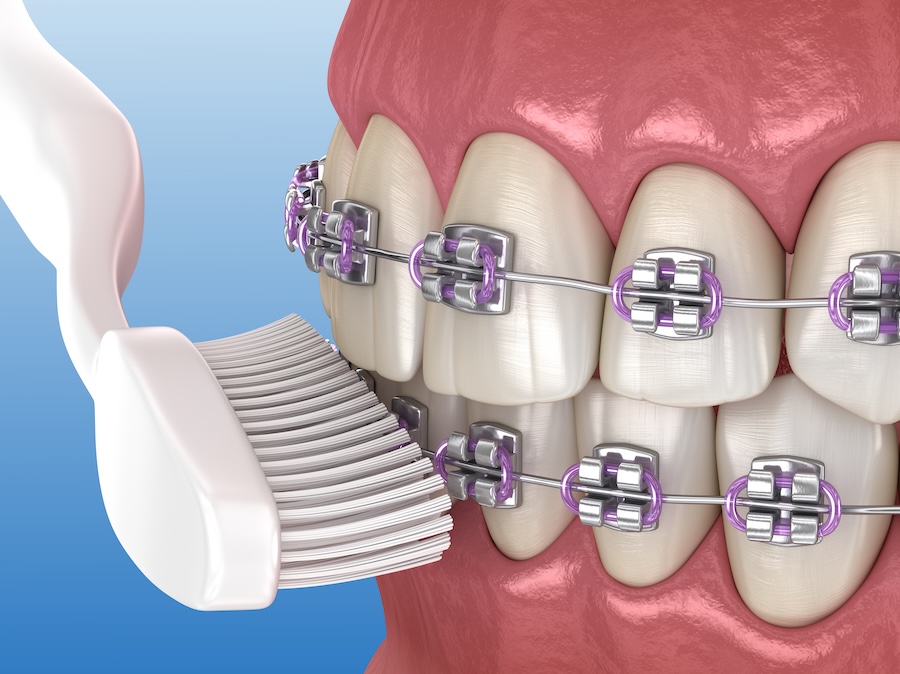
A simple three-angle routine can keep you from missing the same spots every day. Start above the brackets, brush straight across them, then clean underneath them.
First, angle the toothbrush slightly downward so the bristles point toward the tops of the brackets. This reaches the enamel between the gumline and the bracket, where plaque can build up without standing out in the mirror. Use small, gentle motions as you move across each tooth.
Next, hold the brush straight against the front of the brackets and wires. Brush directly across them using short back-and-forth motions or small circles. This cleans the face of the bracket, the wire, and the tooth surface around it. It is the part most people naturally focus on because they can see it clearly, but it still helps to pause over each section rather than sweeping quickly across the whole smile.
Then tilt the brush upward so the bristles reach the bottom edge of the brackets. Food and plaque often settle there after meals, especially around lower brackets and back teeth. Work your way around the mouth in the same order each time so you are less likely to skip an area when you are tired.
The pattern is simple:
- Angle down toward the tops of the brackets
- Brush directly across the brackets and wires
- Angle up toward the bottoms of the brackets
After cleaning around the brackets, brush the chewing surfaces of the molars and the inside surfaces facing your tongue and palate. Those areas do not have brackets, but they can still hold plaque and food just as easily. Finish gently along the gumline, where bleeding and puffiness often begin when plaque has been sitting too long.
Use an Interdental Brush for Small, Stubborn Areas
Because a regular toothbrush cannot reach every edge around a bracket and wire, an interdental brush can fill in some of those smaller spaces.
These small brushes are useful around bracket corners, under the wire, and in areas where food seems to get caught repeatedly. They can be especially handy after lunch or dinner when you feel something stuck but do not have time for a full brushing routine.
Move the brush through those areas lightly rather than forcing it into a tight spot or pressing it into your gums. You are trying to sweep out food and loose buildup, not dig at the braces.
If one area keeps collecting food, make a mental note of it. It may simply need more attention during brushing, or it may be worth mentioning at your next appointment if it never seems to feel clean.
An interdental brush helps around brackets and wires, but it does not replace cleaning between teeth. The sides of teeth still need attention, especially near the gums.
Add a Water Flosser to Rinse Around Wires and Gums
Once you have brushed around the brackets, a water flosser can help rinse out the food that tends to stay tucked under the wire or near the gumline.
Many patients like using one before brushing at night. It can clear larger food pieces first, especially after meals with bread, rice, popcorn, leafy greens, or meat. Then the toothbrush can do a better job focusing on plaque around the teeth and brackets.
A water flosser can also be useful after a meal when you cannot brush right away. It is fast, and it reaches around hardware in a way a regular toothbrush cannot.
Still, it is best to think of it as part of the routine rather than the whole routine. The stream of water can rinse away debris, but floss or another between-the-teeth tool does a better job rubbing against the sides of teeth where plaque can hold on.
Some patients use a water flosser every night and add orthodontic flossers or threaders a few times each week. Others prefer string floss nightly and use the water flosser when they have extra time. The better option is the one you will keep using consistently.
Flossing With Braces Takes More Time, but It Still Counts
Even after brushing and rinsing, the spaces between teeth still need attention. That is where flossing becomes a little more involved with braces, since the wire blocks the usual path.
Orthodontic flossers can make the process easier. Some have a stiff end that helps guide floss beneath the wire, while others are shaped to move from tooth to tooth more quickly. Floss threaders work another way. You place the floss through the loop, guide it under the orthodontic wire, and then floss between the teeth as usual.
Once the floss is in place, curve it around one tooth in a C-shape. Move it gently up and down the side of that tooth, then curve it around the tooth beside it. That helps clean the sides of both teeth rather than simply snapping floss through the middle.
It can feel slow at first. Most people need a little practice before their hands get used to working around the wire. Still, this is one of the places where braces patients can make a real difference in gum health, because a toothbrush cannot reach those narrow spaces as well.
Give the Gumline and Back Teeth More Attention Than You Think
The front brackets are easy to see, so they naturally get most of the attention. The gumline and back teeth are easier to rush through, especially late at night.
However, swollen or bleeding gums often start along the gumline when plaque has been sitting there. If your gums bleed while brushing or flossing, do not automatically avoid that area. Clean it gently and keep an eye on whether the bleeding improves. If it keeps happening, bring it up during your next orthodontic or dental visit.
The back molars also deserve a little extra time. Food can catch behind the last brackets and near the chewing surfaces, where it may not be obvious in the mirror. Brush the cheek side, tongue side, and top of each molar rather than stopping once the front teeth look clean.
Those extra few seconds can make a difference over the course of treatment, especially when braces are on for many months.
White Spots Are Easier to Prevent Than to Deal With Later
All of that careful cleaning adds up for a reason: plaque left near bracket edges can eventually leave behind white spots that are easier to notice once braces come off.
These spots often develop when plaque and acids stay around the brackets for long periods. Frequent sugary drinks, grazing on sticky snacks, and rushed brushing can all make that more likely. One busy week does not usually create a major problem by itself. It is the everyday pattern that shows up over time.
The most useful way to lower the risk is to keep the routine consistent. Brush above, across, and below the brackets. Use fluoride toothpaste. Clean between teeth. Then rinse with water after meals when brushing is not an option.
It may not feel exciting, but the effort pays off when the braces come off and the enamel underneath looks healthy and even.
Check Your Braces Before You Head Back Out
A quick mirror check after eating can save you from walking around with food tucked around a bracket all afternoon.
You do not need to inspect every tooth for five minutes. Just take a look after foods that tend to cling, such as spinach, rice, bread, popcorn, or anything with seeds. Braces can hold food in spots you cannot always feel with your tongue.
A small travel kit makes this easier. Keep a toothbrush, toothpaste, orthodontic wax, a few flossers, and an interdental brush in a pouch that stays in your backpack, purse, car, or sports bag. Then you are not trying to improvise when something is stuck or a wire starts rubbing.
How to Clean Braces Properly in Cherry Hill, NJ
Braces, both metal and ceramic, make brushing and flossing more detailed, but the routine becomes much easier once you know where to aim. Brush down toward the tops of brackets, straight across the brackets and wires, then up toward the bottoms. Afterward, use a water flosser, orthodontic flosser, or floss threader to clean around the wire and between teeth.
At Rock Hill Orthodontics in Cherry Hill, NJ, Dr. Ambika Sharma can help you adjust your routine if you are struggling with food getting stuck, recurring gum bleeding, white spots, or an area that never seems to feel clean. Call the office if a wire is making brushing difficult or you need help finding a flossing option that works with your braces.
Contact UsCategorised in: Ceramic Braces, Metal Braces, Oral Hygiene